


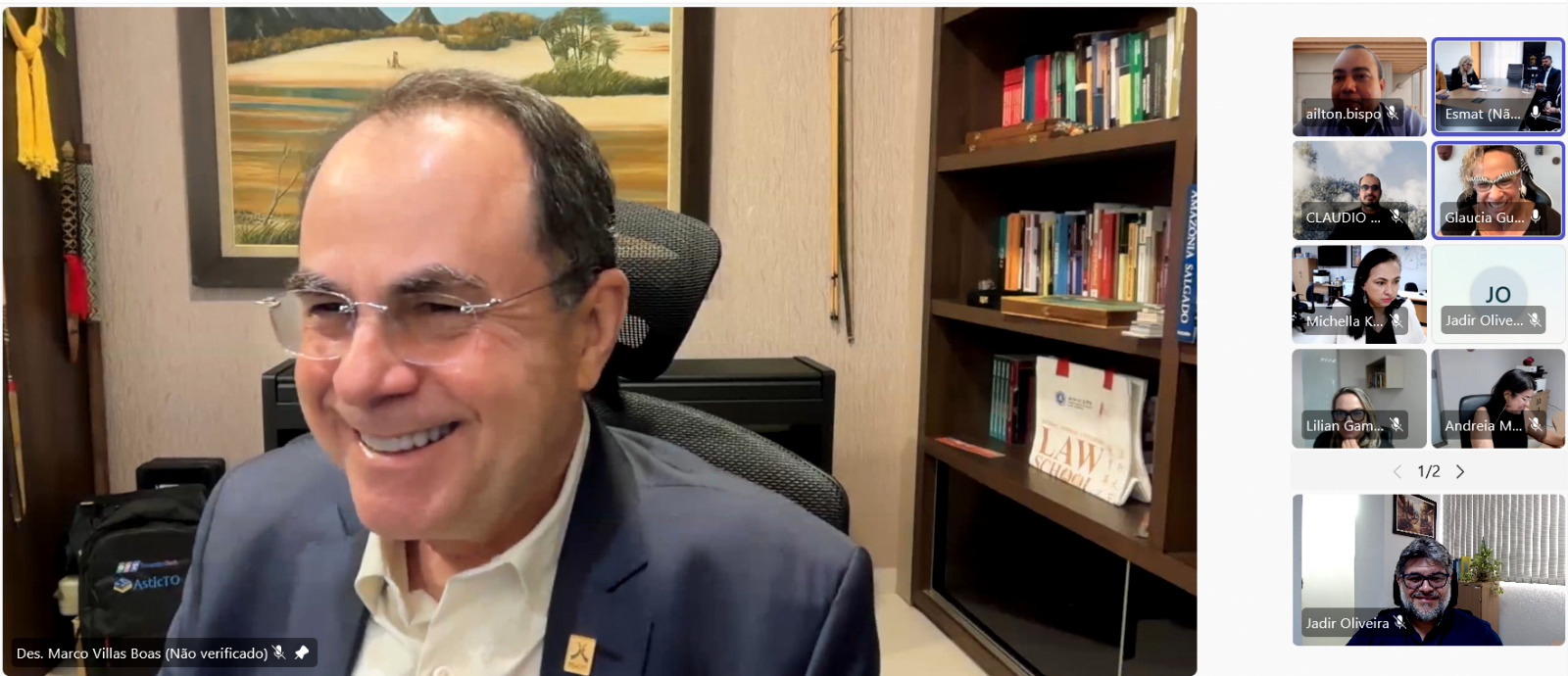
In the last week of November, the Superior School of the Judges of the State of Tocantins (Esmat) began a decisive stage in expanding its academic activities. On the 24th, 25th and 26th, the institution received a virtual visit from evaluators from the Anísio Teixeira National Institute for Educational Studies and Research (INEP), an agency linked to the Ministry of Education (MEC).
What is the purpose?
The goal is to obtain federal accreditation to offer postgraduate courses in the form of distance learning (EaD). Currently, the School already has authorization from the State Board of Education, according to Decree No. 6,981, to offer in-person postgraduate courses.
If accredited by the Ministry of Education for distance learning, Esmat will be able to offer its specializations 100% ONLINE, allowing professionals from all over Brazil to access the courses, making education more accessible and democratic.
How does the evaluation work?
The process follows a strict official protocol (MEC Ordinance No. 183, 2021) and it was conducted remotely, with the same level of rigor as in-person visits. The assessments included interviews with managers, technical staff, professors and students; analysis of institutional documents; and a virtual guided tour of the physical facilities of Esmat, such as classrooms, library, administrative departments, auditorium, and technology infrastructure.
The visit was attended by the following experts: Ailton Bispo dos Santos Junior, PhD in Administration from the University of the city of Brasília (UnB); Glaucia Paula Bernardes Guarany, PhD in Public Policy and Human Development from the University of the State of Rio de Janeiro (UERJ); and Claudio Zancan, PhD in Administration, with an emphasis on Innovation and Inter organizational Cooperation Networks (UnB).

During the closing meeting, the general director of Esmat and president of the Permanent College of Directors of State Schools of the Magistracy (Copedem), Justice Marco Villas Boas, highlighted the trajectory of the institution as a benchmark in innovation, planning, and legal training.
“I am here, feeling humbled, flattered, and very gratified, along with my entire team, because this is a community effort, a collective effort (...). We are showing a different reality; we are delivering products to the community to improve institutions and improve the lives of people. Today there are dozens, hundreds of projects in our banks, many of them awarded nationally and internationally (...). I am very excited about all this," he said, upon hearing the positive points highlighted by the evaluators.
Judge Wellington Magalhães, deputy director of the Course Council of Esmat, also spoke, reinforcing the role of the School in the pursuit of a Justice System that is more sensitive to the Brazilian social reality. “In recent years, the school has promoted, through research, bringing knowledge to magistrates and civil servants (...). Our role here is to reaffirm our commitment to excellence in judicial services, because we know that, through the judiciary, we can build a better society,” he said.
Judge Roniclay Alves, also deputy director of the Council for Superior Studies and Scientific Research of the School, highlighted the institutional impact of the management and organizational culture of Esmat. "The main concern here is to ensure that everyone who passes through this institution delivers better results in the administration of Justice. I am absolutely certain that Esmat has fulfilled this role with mastery. Here, the environment is different, and you can feel it," he commented.
On the occasion, the executive director of the School, Ana Beatriz de Oliveira Pretto, thanked the team and the evaluation committee for listening and for their technical contributions throughout the inspection.
“I would like to take this opportunity to thank our team of civil servers. I often say that it was a planetary alignment that brought us together here. The dedication, spirit of cooperation, and common purpose are evident in the results we have achieved," she shared.
At the end of the meeting, the members of the committee reported that they had been positively impressed by the high level of professionalism of the Esmat team and the commitment shown at all stages of the process. According to the evaluators, although they frequently visit public educational institutions, the Superior School of the Judges of the State of Tocantins stands out from the rest for its organization, methodological consistency, and the way in which pedagogical principles are integrated into the work routine.
Esmat remains committed to the legality of its educational processes and to the continuous improvement of the quality of its courses. For this reason, it seeks federal accreditation as another strategic step to expand access and strengthen academic excellence.
The results of the evaluation have not yet been released, but the School already recognizes and values the process itself as an essential step in its institutional growth, whose contributions directly impact the improvement of services provided to the Judiciary of the state of Tocantins and legal education in Brazil.
_thumbnail_thumbnail.jpeg)
_thumbnail_thumbnail.jpeg)
_thumbnail_thumbnail.jpeg)
_thumbnail_thumbnail.jpeg)
_thumbnail.jpeg)
_thumbnail.jpeg)
_thumbnail.jpeg)
_thumbnail.jpeg)
