


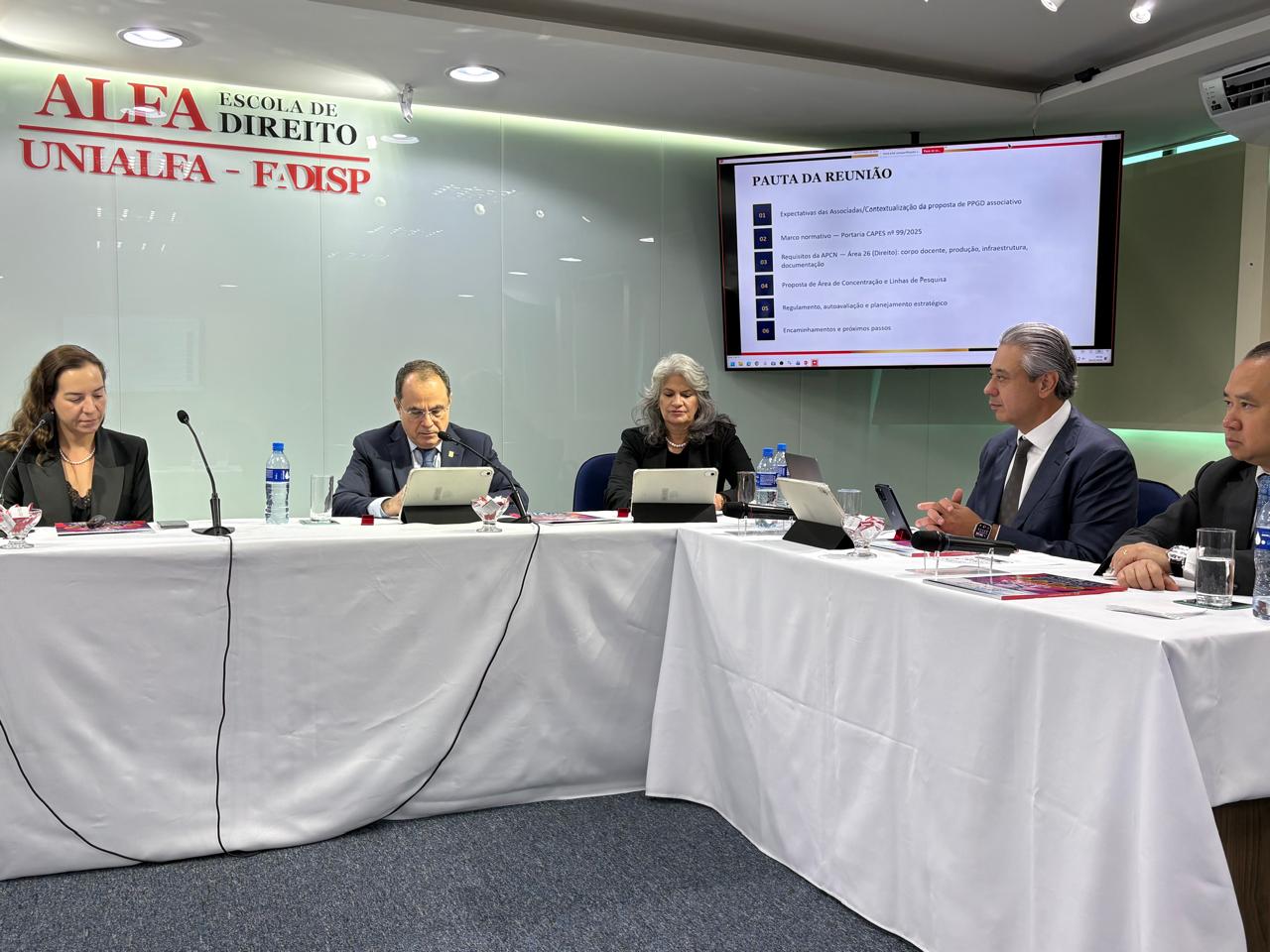
The possibility of creating a new doctorate in Law involving institutions of the Justice System began to take shape on the morning of this Friday (March 6th), during a meeting held at the Law School of Alfa Education (Fadisp/Unialfa), in the city of São Paulo (SP).
The meeting brought together the general director of the Superior School of the Judges of the State of Tocantins (Esmat) and president of the Permanent College of Directors of State School of the Magistracy (Copedem), Justice Marco Villas Boas; the director of Fadisp, Thiago Lopes Matsushita; the executive director of Esmat, Ana Beatriz de Oliveira Pretto; the federal Judge, Cíntia Menezes Brunetta (TRF5th Region (Federal Regional Court)); Judge Antonio Peleja Junior (TJMG (Court of Justice of the state of Minas Gerais)); and the Doctor Professor Lauro Ishikawa.
The meeting marked the beginning of negotiations for the construction of a Law Post graduation Program in an associative format, an initiative that involves Fadisp, Copedem and judicial and magistracy schools from various regions of the country. The proposal seeks to structure a network doctorate, focusing on legal research and academic qualification of magistrates, civil servers, and researchers connected to the Justice System.
For Tocantins, the initiative represents a strategic opportunity. The creation of a doctorate would broaden access to high-level academic training in the area of law and strengthen scientific production linked to contemporary demands of the judiciary and society.
During the meeting, central aspects for the elaboration of the academic proposal were addressed, such as the definition of the area of concentration and possible lines of research capable of meeting the demands of the associated institutions.
Also analyzed the criteria and requirements required by the Coordination of Improvement of Superior Level Personnel (Capes) for the creation of new graduate programs, including faculty structure, scientific production, the teaching and research infrastructure and the organization of the program regulations.
In the associative model, two or more teaching and research centers can jointly offer master’s or doctoral programs, sharing academic structure, faculty and research projects. This modality seeks to expand networks of scientific cooperation, strengthen research groups and reduce regional disparities in the supply of graduate studies in the country.
According to the discussions of the meeting, the next step will be the consolidation of the academic proposal, which should be submitted to Capes through the evaluation of the Proposal of New Course (APCN). At this stage, elements such as the coherence of the pedagogical proposal, the qualification of the faculty and the scientific and regional relevance of the program are analyzed.
The institutional agenda of the justice follows with the provision for another meeting, this time focused on the preparation and programming of the Copedem Congress of 2026, scheduled to take place from March 26th to 28th in the state of Bahia.
