


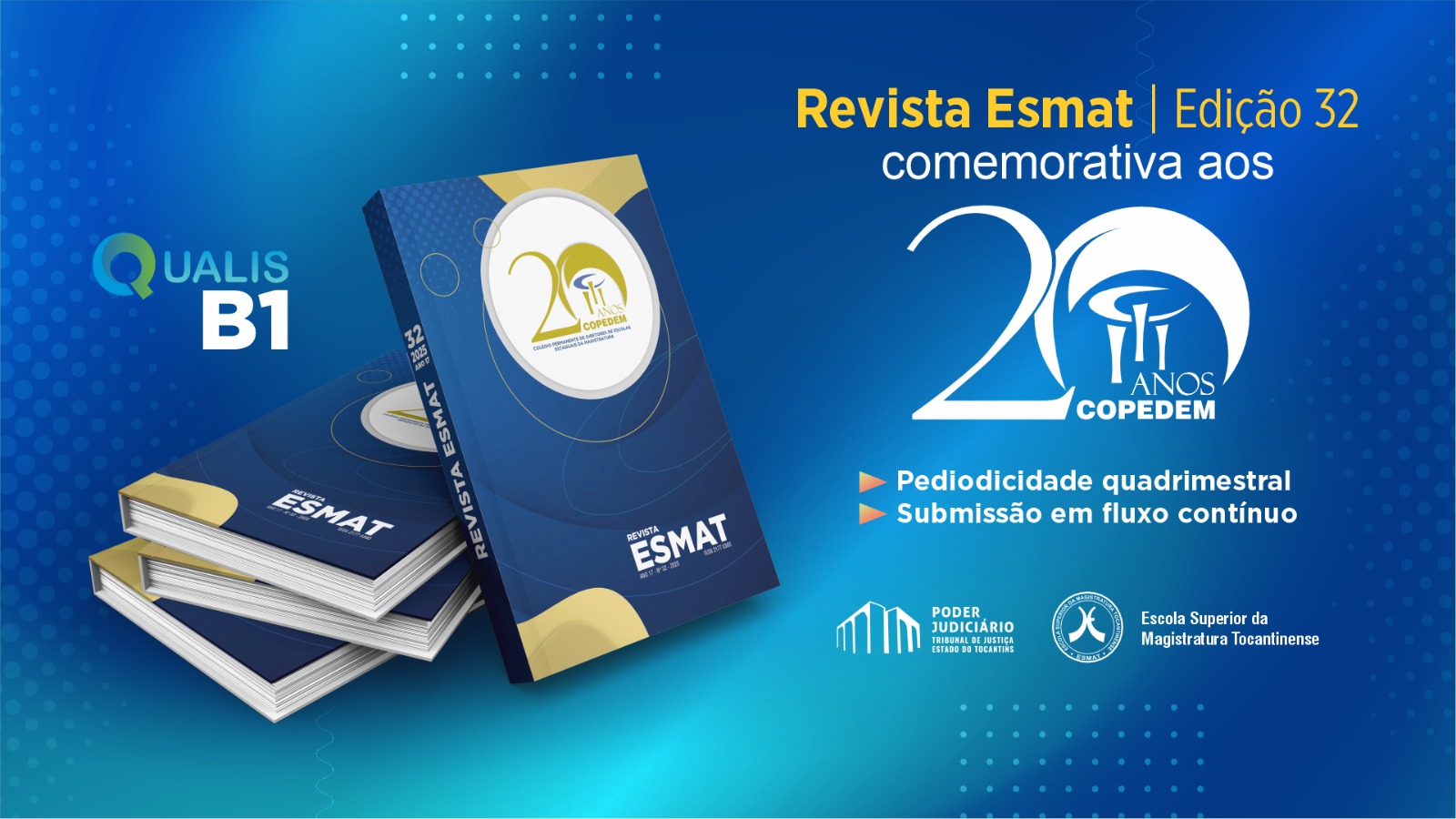
The Superior School of the Judges of the State of Tocantins launches, on Thursday (Dec 18th), the 32nd edition of the ESMAT journal, a quarterly scientific publication linked to the Associative Program of Post-Graduation in Judicial Provision and Human Rights (UFT/ Esmat). This special edition pays tribute to the Permanent College of Directors of State Schools of the Magistracy (Copedem), celebrating its 20 years of activity in articulating, strengthening and innovating judicial education in Brazil.
The cover text is signed by Justice Marco Anthony Villas Boas, president of the College and general director of Esmat, which highlights the strategic role of judicial education in consolidating democracy, jurisdictional efficiency and rights culture.
Consolidated as a space for critical reflection and academic production of excellence, the ESMAT Journal reaches its 32nd edition bringing together 14 scientific articles, 11 national and three international, maintaining the editorial policy of 100% exogenicity, with authors from various regions of the country and abroad. The edition reaffirms the commitment to interdisciplinarity, internationalization and dialogue between Law and Applied Social Sciences, while recognizing the strategic role of Copedem in the initial and continuing training of the Judiciary and the improvement of judicial provision.
Thematic
The published works address contemporary themes sensitive to the democratic agenda and human rights, such as urban planning from the perspective of eco feminism, sustainable, smart and inclusive cities; surveillance capitalism, data protection and fundamental rights; efficiency and supervision of notary and registration activities by the CNJ; gender, sexuality and recognition, with debates on mononormativity and rights of transsexual women; legal psychology and its contribution to a more humanized justice; judicial control of police activity and inviolability of the home; performance of the Judiciary network in confronting violence against women; banking compliance in agribusiness; digital transformation and innovation in public administration; besides bank fraud, legal certainty and transnational challenges in the context of the BRICS.
For more information on guidelines for authors, click here.
