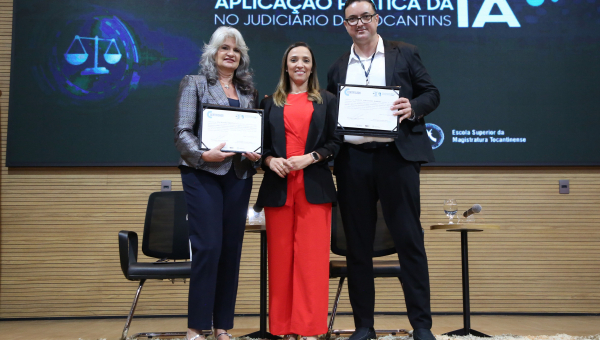
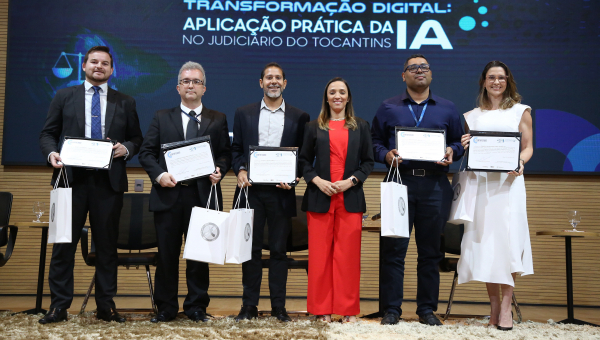
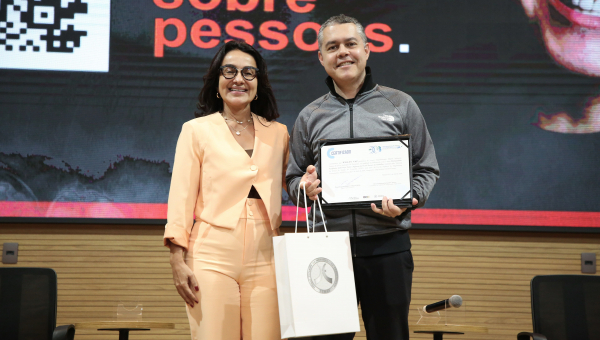
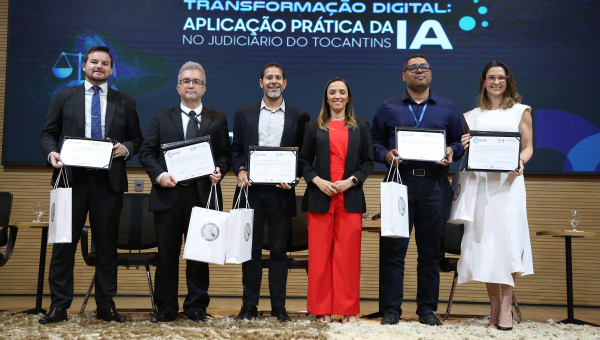
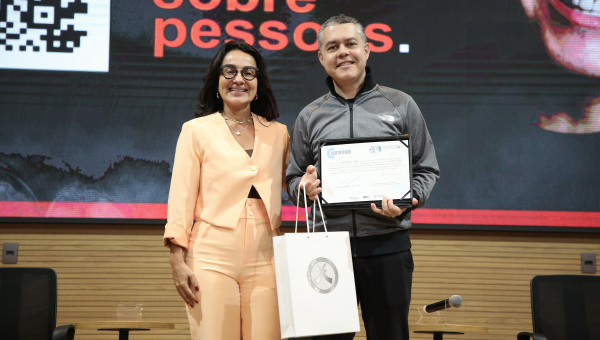
The continued programming of the event on "Digital Transformation: Practical Application of AI in the Judiciary of the state of Tocantins" highlighted experiences already developed within the Court of Justice of the State of Tocantins (TJTO). One of the main focuses of the exhibition was on the doctorates from the post graduation program in Governance and Digital Transformation, the executive director of the School, Ana Beatriz Pretto, and the Esmat Control supervisor of Esmat, Vinícius Fernandes Barboza, on the panel: "LIIARES Ecosystem: Transforming Management with the MBA in Applied AI and Agents for Artifact Automation”.
LIIARES: applied research and a safe environment for innovation
Presenting the Laboratory of Interdisciplinary Artificial Intelligence of ESMAT (LIIARES), Ana Beatriz explained that the proposal comes from the need to create an institutional environment focused not only on the debate about technology, but also on the construction of concrete solutions.

“LIIARES is born from the understanding that digital transformation in the Judiciary requires more than institutional interest in technology. It also requires an appropriate environment for research, experimentation and the development of concrete solutions", she said.
In the same line, she highlighted the role of the Laboratory as a space for academic and institutional development linked to the School. "The Laboratory was designed to allow students, researchers and collaborators linked to Esmat to develop studies, applied research and proposals aimed at improving the services provided by the TJTO", she clarified.
From research to solution development
Next, Vinícius presented the first product of LIIARES, developed from his doctoral research. The tool was designed to support the planning phase of public procurement, especially in the preparation of the artifacts required by the Law No. 14.133 of 2021 and the Normative Instruction of the TJTO No. 4 of 2023.
During the exhibition, he detailed the steps that make up this flow, highlighting the Demand Formalization Document (DFD), the Preliminary Technical Study (ETP), the Risk Management (GR) and the Terms of Reference (TR).
To support the proposal, Vinícius presented data from a survey with 60 civil servers that work in the preparation of these documents. According to the results shown, among the main difficulties faced are technical and justification analysis, interpretation of requirements, application of the standard, internal information collection and deadlines for preparation.

Data on average production time, rework and factors that compromise productivity, such as the absence of support tools and difficulties in normative interpretation were also exposed. Based on this diagnosis, a multiagent solution with artificial intelligence support was presented, structured in four fronts: DFD.AI, ETP.AI, GR.AI and TR.AI.
The proposal is to guide and standardize the elaboration of artifacts, using the official models of the TJTO, legal requirements and institutional flows already defined, always with stages of approval and human supervision. In explaining the logic of the tool, Vinícius stressed that AI should be understood as a support for technical work.
“When I talk about help, it’s because we have to think of the AI tool as a support tool; it won’t solve all our problems without human supervision," he said.
At the end, Vinícius showed the results of the pilot project applied in the Control Supervision of Esmat, in contracts with different objects. According to the data presented, the tests indicated an average reduction in time of 84.2% in the preparation of artifacts, as well as potential for reducing rework, increasing regulatory compliance, and greater agility in hiring flows.
AI ecosystem tools of the TJTO
Before this panel, the programming also brought to the table: "Digital Transformation Program: Artificial Intelligence in the Judiciary of the state of Tocantins", with the participation of Márcio Vieira dos Santos, Ivo Pontes Araújo, Harly Carreiro Varão and Pamela da Rocha Pires Ferreira, under the mediation of Angelo Stacciarini. The activity was dedicated to present technological solutions already in development at the Court.

Among them, Márcio Vieira dos Santos presented dIArio, a research agent with artificial intelligence focused on the collection of the Gazette of Justice. According to him, the tool allows the user to make searches in natural language.
“Basically, today the person will enter the Gazette of Justice and will 'talk' to the Gazette, as if asking someone to find, for example: find the publications that came out with my name last week, and AI will help the person find these publications", he explained.
He also informed that the new Gazette gathers more than 6,300 editions, with 37 years of publication, since May 2nd of 1989, and that research with AI already works for editions from 2005.

Márcio also highlighted another feature of the tool: the simplification of the content of publications. "If the person finds the desired publication, such as a summons, but does not understand the difficult words, which is common with the population, the Gazette now offers a button 'Simplify for me', and this translates the document into simplified language," he added.
Pamela da Rocha Pires Ferreira presented the GAIA platform, focused on the end-activity of the Judiciary. According to her, the solution brings together resources for consultation and summary of processes, as well as support in drafting minutes.
“GAIA is a specialist in the preparation of legal texts. It’s not the judge that adapts to the tool; it’s the tool that adapts to the magistrate, with a functionality and a model that learn writing, the style of writing of the magistrate, and this makes all the difference in using artificial intelligence,' she said.
Pamela also pointed out that the context used in the drafts does not remain stored, in compliance with the regulations of the National Council of Justice. "Finished a new draft, that context erases", she completed.
The Board also included the presentation of other projects that integrate the AI ecosystem of the TJTO. Ivo Pontes Araújo showed the AI Agents with Gemini, focused on administrative and support areas, with use in routines such as text editing, spreadsheets, data analysis and reporting. Harly Carreiro Varão, in turn, presented GiseLI and the Cortex. The latter has been described as a central technological center for standardizing access to AI models, while GiseLI acts in the automation of extrajudicial supervision by the General Internal Affairs of Justice.
Expanded humanity and leadership in the age of AI
The lecture on "Expanded Humanity: Leadership, Value and AI Agents in the Future of Work", delivered by Wesley Vaz, proposed a reflection on the impacts of artificial intelligence in organizations, especially on the role of leadership in digital transformation contexts.

The lecturer addressed AI not only as a technological tool, but also as an element that alters decision flows, labor relations, productivity models and forms of human interaction. Throughout the exhibition, Wesley highlighted that the biggest challenge today is not only technical but also relational, cultural and ethical, requiring environments based on trust, purpose, integrity and awareness about the use of new technologies.
Among the central points, he dealt with the concept of "expanded humanity", arguing that artificial intelligence expands existing capabilities, but does not replace the human dimension of decision-making.
“Whoever decides to use AI in a professional and intense way as you have decided, know that the only way to be right is by reinforcing human roles and these are not what AI does", he pointed out.
The presentation also explored the advancement of AI agents, the growth of so-called AI-First organizations, the limits of superficial adoption of generative tools and the need to transform use into concrete outcome. In this context, it was emphasized that the adoption of AI solutions generates real impact only when it is integrated into workflows, learns from feedback, and connects to clear institutional goals.
“What do we know about the future? That it will be different? Every future is different. Second, it exists today somewhere. You are certainly a reference for some Courts of Justice, the TJTO is the future of some institutions, and perhaps you can be inspired by other institutions (...)", he commented.