


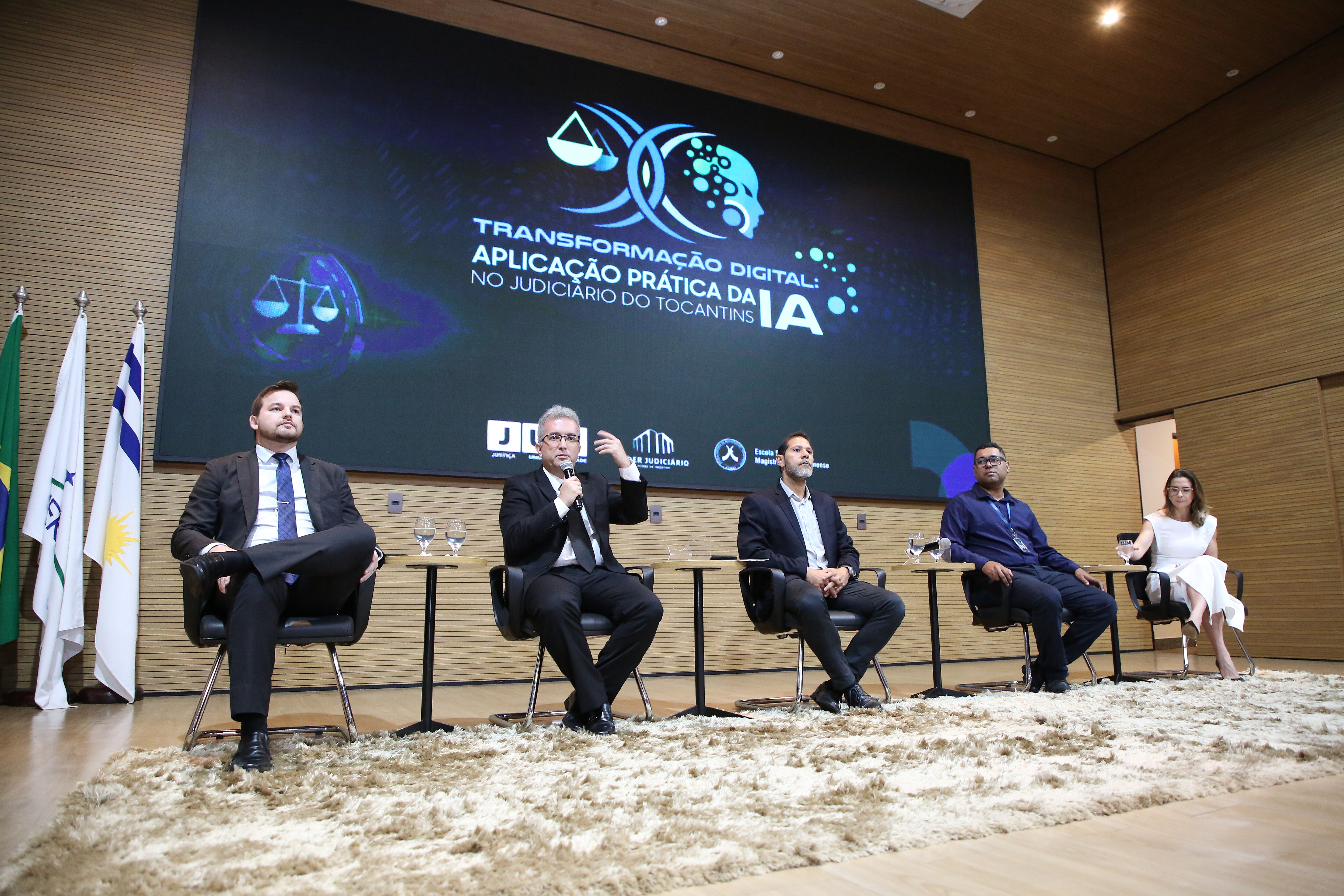
Approved and developed by the Court of Justice to raise its technological maturity, the Digital Transformation Program of the Judiciary of the state of Tocantins reached a new milestone on Monday (April 6th) with the launch of two artificial intelligence platforms. The "Gazzette of Justice with AI" modernizes the official publication by bringing features for research and simplification of legal language, and GAIA, a platform integrated to the eproc procedural system.
The technological innovations were made available after the special presentation at the event on "Digital Transformation: Practical Application of AI in the Judiciary of the state of Tocantins", held in the auditorium of the TJTO.
At the opening of the event, the president of the TJTO, Justice Maysa Vendramini Rosal, stressed that the Judiciary of the state of Tocantins is recognized by the National Council of Justice (CNJ) as an innovative court that has achieved the level of excellence in governance ranking, management and information technology infrastructure, highlights that encourage "seeking solutions and innovations that contribute to the delivery of an increasingly efficient justice to citizens.”
According to the president, the Digital Transformation Program of the Judiciary of the state of Tocantins is responsible for building this path, with security and ethics, which represents "a true ecosystem of artificial intelligence", with solutions such as GAIA, the agents of Cortex, Gisele and the Gazette of Justice with AI.
"It is a strategic initiative that elevates the technological maturity of our institution. It allows, with each new step, the improvement of the judicial service. A conscious, responsible and also solid transformation. We work governance to ensure clear guidelines and compliance”.
Gazette and GAIA tools
The new gazette, developed by civil servers of the TJTO, contains all downloadable editions and covers 37 years of publication, since May 2nd of 1989, date of the edition number 1, and a total of more than 6,300 diaries. Research with AI is already operational for editions from 2005. The oldest PDFs are being processed, and soon it will be possible to research 100% of the collection, as explained by the system analyst and head of the Service of Development of Solutions on Administrative Support Systems of the TJTO, Márcio Vieira dos Santos, when presenting the Gazette, research agent with Artificial Intelligence.
“Basically, today the person will enter the Gazette of Justice and will 'talk' to the Gazette, as if asking someone to find, for example: find the publications that came out with my name last week, and AI will help the person to find these publications," he said.
The new diary has another AI that simplifies any publication found in its database for the user. "If the person finds the desired publication, such as a summons, but does not understand the difficult words, which is common with the population, the Gazette now offers a 'Simplify for me' button that translates the document into simplified language," he continued.
The civil server Pamela da Rocha Pires Ferreira, active in the implementation and legal and technical support of eproc, presented the GAIA platform, aimed at the end-of-life activity of the Judiciary. The AI includes the GAIA Assistant, for consultation and summary of processes, and the GAIA Draft, which assists magistrates in the personalized drafting of decisions, that is, the platform learns to use the style of each judge when deciding.
“GAIA is a specialist in the elaboration of legal texts. It’s not the judge that adapts to the tool; it’s the tool that adapts to the magistrate, with a functionality and a model that learn the writing, the style of writing of the magistrate, and this makes all the difference in using artificial intelligence," she explained.
She also cited that the context used as a basis for the decision is not saved, unlike generic AIs. "Finished a new draft, that context deletes what we do not really have from the use of other AIs; you do not know what happens with that file of the process," she added, reminding us that it is a measure that meets the regulations of the National Council of Justice.
Other tools
Other projects that are part of the AI ecosystem of the TJTO, to modernize and humanize judicial and administrative services, were also at the roundtable of the event. Ivo Pontes Araújo, system programmer at the TJTO, presented the project on "AI Agents with Gemini", which is directed to administrative and support areas, using generative AI to increase efficiency in daily routines, as text editing, spreadsheets, data analysis and reporting.
The developer of extrajudicial systems Harly Carreiro Varão spoke about GiseLI and the Cortex. The latter acts as a central technological center, simulating the "human brain" to standardize access to AI models, while GiseLI is a tool that automates extrajudicial inspection by the General Internal Affairs of Justice.
