


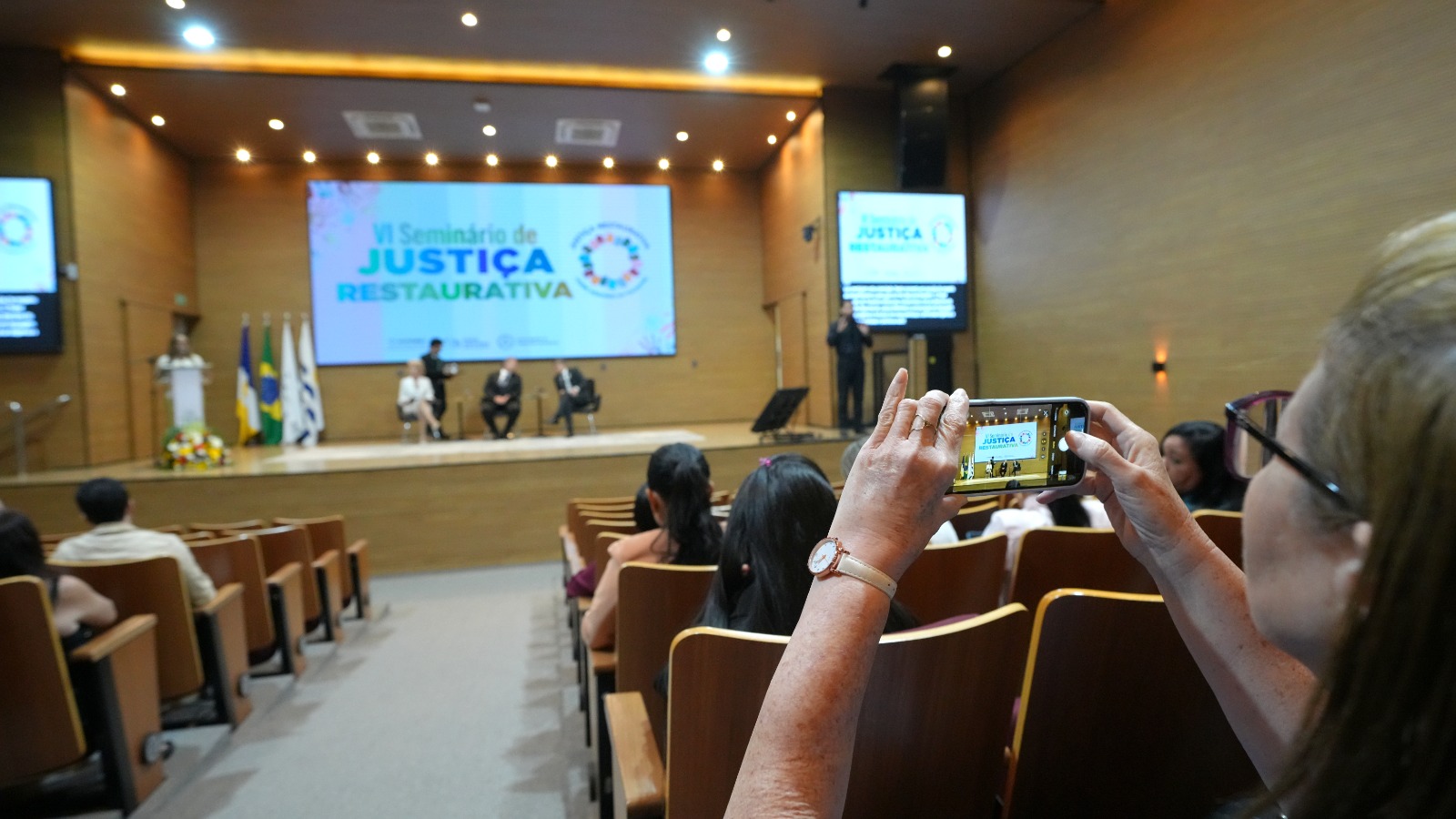
The Court of Justice of the State of Tocantins (TJTO), through the Permanent Center of Consensual Methods of Conflict Resolution (Nupemec) and the Superior School of the Judges of the State of Tocantins (Esmat), held on the morning of Friday, Dec 5th, the opening of the IV Seminar on Restorative Justice. The event brought together magistrates, officials, professors, researchers, students, representatives of partner institutions and members of the civil society.
The assistant judge of the Presidency of the TJTO, Ariostenes Guimarães Vieira, represented the president of the Court, Justice Maysa Vendramini Rosal. The coordinator judge of Nupemec, Silvana Maria Parfeniuk, followed the programming and reinforced the importance of the meeting to strengthen public policies for social pacification in the State.
Opening with focus on prevention of violence among adolescents
The first lecture was conducted by Judge Vanessa Cavalieri, holder of the Court for Children and Youth of the state of Rio de Janeiro, and idealizer of the "I See You" Protocol initiative nationally recognized for mapping invisible factors that precede situations of violence among adolescents.
Vanessa explained that violence is often a "symptom of unmet needs," such as belonging, bonding, listening and affection. She reinforced:
"From this look at what is invisible, we understand that violence is born of ignored emotional needs. The school and the family need to be attentive to help children and adolescents relearn how to live together in a healthier and more loving way."
The judge also detailed aspects of the I See You protocol, which addresses topics such as BULLYING, Mental Health, Early Screen Use, Suicide Prevention and Increased Episodes of Aggression within the Family Environment - especially between 11 and 14 years, a phase considered critical. When talking about the ban on using mobile phones in schools, Vanessa contextualized:
“Early use is harmful and it has direct impacts on sleep, behavior and mental health. International studies, such as PISA, show that the feeling of loneliness in schools has increased sharply since the SMARTPHONE became part of the school routine. Remove the mobile from the playground is to stimulate real conviviality - play, talk, connect with each other”.
Prison Systems, Restorative Justice and Trajectory Reconstruction
The second participation of the morning came from the state of Maranhão. Mirella Cezar Freitas, researcher, trainer at Enfam and member of national Restorative Justice groups, spoke remotely about ways to rebuild the penal system. She presented the IYA Project, on which she has been working for six months with 60 women, reinforcing that social reintegration is not charity: it is justice.
The magistrate highlighted that the central axis of work is qualified listening, dignity and recognition as tools of transformation essential elements to break cycles of violence and recidivism. The panel was mediated by Judge Allan Martins Vieira, president of the Association of Magistrates of the state of Tocantins (AMT). For him, the seminar has a strategic role in strengthening the culture of peace in the State:
“Restorative Justice is a public policy encouraged by the CNJ and it seeks to hold accountable, generate recognition and resolve conflicts effectively. Many of these conflicts do not cost much to the Judiciary and, when conducted in a restorative manner, have a real impact on the lives of people.”
The magistrate also recalled the relevance of the examples brought from the state of Maranhão: "I just chaired a Table on restaurativity in the female prison system. The state of Maranhão, which was once the worst in Brazil, today has the best prison system in the country. And one of the mechanisms that support this turn is precisely the Restorative Justice. Post-prison follow-up avoids recidivism and welcomes women who have already arrived marked by exclusion".
_thumbnail_thumbnail.jpeg)
_thumbnail_thumbnail.jpeg)
_thumbnail_thumbnail.jpeg)
_thumbnail_thumbnail.jpeg)
_thumbnail_thumbnail.jpeg)
_thumbnail_thumbnail.jpeg)
_thumbnail_thumbnail.jpeg)
_thumbnail_thumbnail.jpeg)
_thumbnail.jpeg)
_thumbnail.jpeg)
_thumbnail.jpeg)
_thumbnail.jpeg)
_thumbnail.jpeg)
_thumbnail.jpeg)
_thumbnail.jpeg)
_thumbnail.jpeg)
