


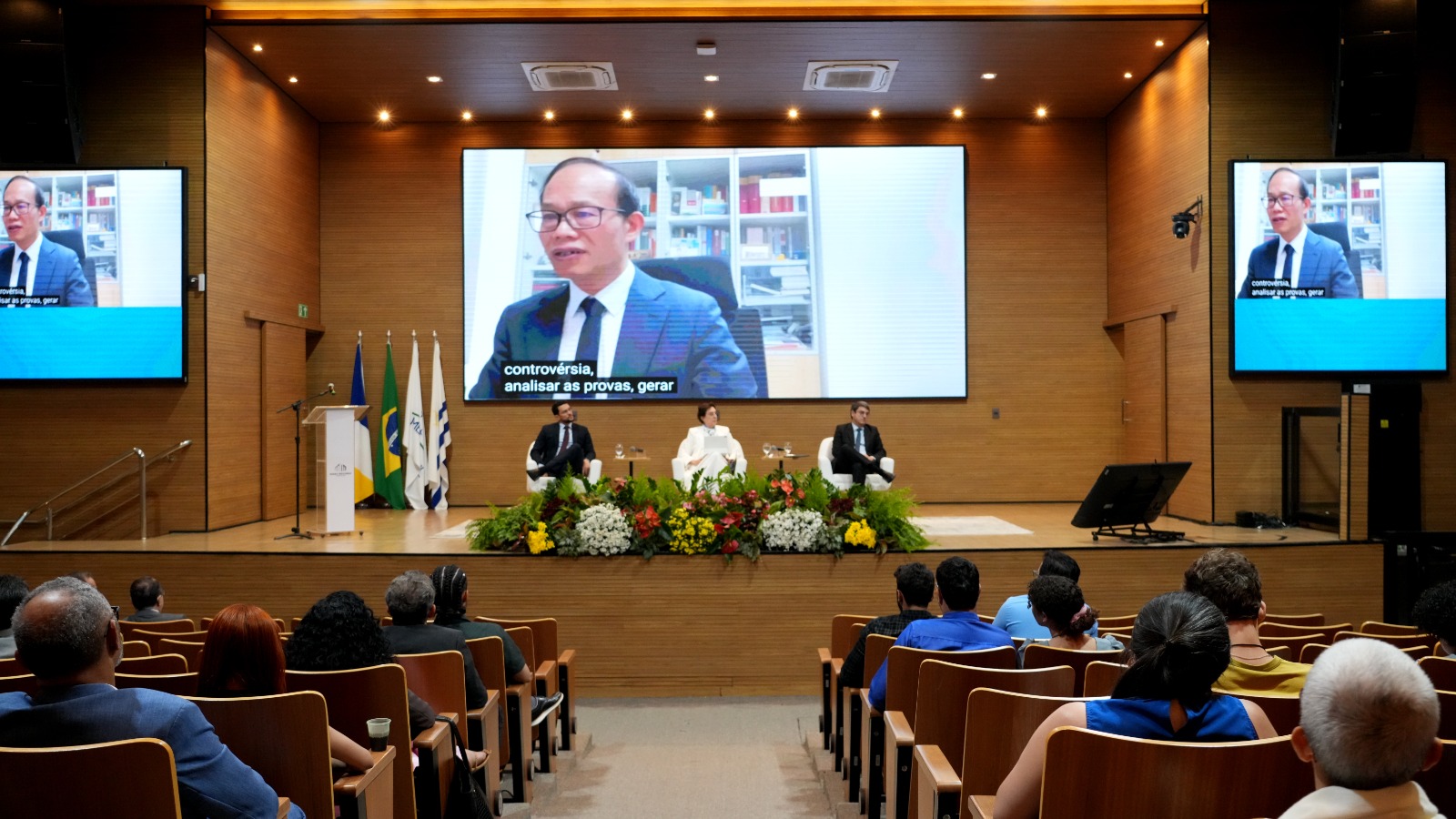
The third day of the XVIII International Congress on Human Rights brought reflections on the advances of Artificial Intelligence (AI) and its effects on the Justice System and Human Rights. The lectures of this Thursday (November 13th), held in the auditorium of the Court of Justice of the State of Tocantins (TJTO), brought together experts from Brazil, China and Spain to discuss the new challenges of the digital age and the human role faced by technological transformations.
The first panel of the afternoon addressed the theme on "Judiciary: the challenges of governance and transparency with the advent of AI", with the participation of doctor Luís Fernando Bandeira de Melo Filho, from the Federal Senate, and Professor Zhao Shuhong, from Beijing University, under the mediation of Ângela Issa Haonat.
When discussing the impact of technology on the functioning of the Judicial System, Professor Zhao Shuhong pointed out that Artificial Intelligence has been an ally in optimizing processes and standardizing decisions. According to him, the use of AI has relieved the burden on the Judiciary and increased efficiency in procedural analysis.
“AI is efficiently improving judicial practice, relieving pressure on court appeals, reducing human error and promoting standardization of judicial decisions," he said.
From the perspective of doctor Luís Fernando Bandeira de Melo Filho, it is necessary to be cautious in the use of technology within the Judicial System. He stressed that, despite the benefits brought by Artificial Intelligence, the human factor remains essential in the decision-making process.
“I still prefer human error to robot error. The robot is good at controlling. AI should be used preferably in the corporate system, for the numerous advantages it offers", assessed.
At the time, there was also the delivery of the Medal of the Founders Justice Paulo Ventura, in celebration of the 20 years of the Permanent College of Directors of State Schools of the Magistracy (Copedem).
The honor was presented by Justice Marco Villas Boas, general director of the Superior School of the Judges of the State of Tocantins (Esmat) and president of Copedem, to doctor Luiz Fernando Bandeira de Mello Filho, in recognition of its contribution to the strengthening of judicial education institutions and the dialogue among the powers.

In legal proceedings and human rights
The second panel of the afternoon had as theme: "The impacts of artificial intelligence on legal processes and human rights", with the participation of Professor Raul Márquez, from the University of Barcelona, and Justice Pedro Valls Feu Rosa, from the Court of Justice of the state of Espírito Santo (TJES), under the mediation of Dr Antônio Carlos dos Santos, from the Post-Graduation Program in Judicial Provision and Human Rights (PPGPJDH).
During the debate, Professor Raul Márquez drew attention to the need to understand the social and ethical implications of technological progress, arguing that research is the way to overcome fear and face change responsibly.
“We need to analyze the effects and problems that appear in everyday life to face them, overcoming fears through research before society and technology", pointed out.
Justice Pedro Valls Feu Rosa, in turn, made a warning about the uncritical stance with which society has received technological innovations. According to him, the enchantment with modernity has led people and institutions to accept changes without reflection.
“Our fascination with technology is so great that we have accepted everything it gives us without question, wanting to pass on a vision of modernity", he observed.
Education
Extending the debate beyond the courts, the programming also opened space to discuss how Artificial Intelligence is transforming education. The technological advance, which already redefines professions and forms of communication, also challenges schools and universities to rethink teaching methods, digital security and professors training.
It was in this context that the senator Professor Dorinha Seabra brought a reflection on the need to prepare educators and students for this new scenario.

Closing the panel, the senator highlighted the importance of investing in digital education and preparing teachers and students to deal with technological transformations. For her, learning together is essential to ensure safety and inclusion in this new scenario.
“I do not have knowledge of everything; let’s learn together. We need to go a long way in the digital and technological issue, finding ways to overcome barriers. The school needs to have security, the students as well, it is essential to seek ways of working with technology in an aligned way within the classroom, so that the students can use these resources in favor of education and be able to make conscious decisions", she said.
