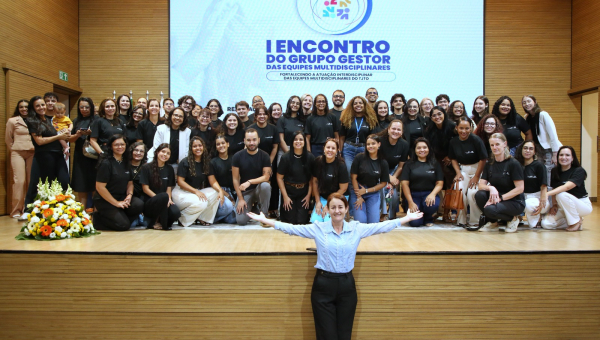
The afternoon programming for Thursday (Nov 27th) at the First Meeting of the Management Group of Multidisciplinary Teams (GGEM) began with a lecture entitled on “Methodology of Interdisciplinary Work at GGEM,” presented by the general coordinator of the group, Social Worker Jocelaine Lago Dalanora. The event, held by the Judiciary of the state of Tocantins through the Superior School of the Judges of the State of Tocantins (Esmat), brought together accredited professionals from the fields of Psychology, Social Work, and Education with the aim of deepening and consolidating the interdisciplinary technical advisory methodology adopted by the GGEM.
During her presentation, Jocelaine recounted the history of the development of the methodology and explained that this meeting marks an institutional advance, as it represents the first formal space dedicated to the exchange of experiences, dialogue, and collective reflection on the work of the teams. She emphasized that interdisciplinary technical assistance integrates different areas of knowledge to offer specialized support in a coordinated and qualified manner, overcoming the logic of isolated action.
“It is in this space of exchange that an integrated synthesis of knowledge is constructed," she emphasized.
The coordinator emphasized that the Interdisciplinary Technical Assistance (ATI) is one of the main tools for qualifying judicial decisions, especially in cases involving social, psychological, and educational factors. “What we seek is interdisciplinarity: professionals who work together, build shared syntheses, and generate a unique and well-founded understanding of the case,” she said. She then reinforced: “Qualified technical decisions only exist when there is a dialogue between areas and when all perspectives are intertwined.”
Jocelaine also presented the normative basis that guides the actions of the teams, including resolutions from the National Council of Justice (CNJ), Law No. 13,431 of 2017, the Statute of Children and Adolescents, the Maria da Penha Law, and alignment with the Strategic Plan of the TJTO. She explained that the ATI is structured around three pillars—specialized care, technical support, and ongoing training—developed in four standardized phases, which ensure the quality of the work performed by the 1,638 professionals accredited in the network.
The programming continued with the Round of Conversation on “Interdisciplinary Work at GGEM: Challenges, Results, and Opportunities,” led by the supervisor of Programs and Projects and Social Worker Ana Paula Xavier Alves; Regional Center supervisor and Educator Suelen Christiane Milhomem da Silva Borges; and the administrative and financial supervisor of the group, specialist Leonardo Nunes Aires. The moment allowed for technical deepening, direct exchange with the network, and alignment of strategies aimed at strengthening the interdisciplinary model.
At the end of the programming, Jocelaine emphasized that the Meeting marked a decisive step toward the consolidation of interdisciplinary work in the Court. For her, the dialogue with the professionals of the network strengthens ties, improves the support offered, and expands the space for listening to the needs of the team. The coordinator stated that the reflections produced will serve as the basis for the planning of GGEM in 2026 and reinforced the commitment of the group to technical excellence.
"This meeting is the foundation for making GGEM a benchmark in interdisciplinary technical evaluation and for contributing to a Court that is increasingly modern, sustainable, and committed to the quality of its decisions," he concluded.
_thumbnail_thumbnail.jpeg)
_thumbnail_thumbnail.jpeg)
_thumbnail_thumbnail.jpeg)
_thumbnail_thumbnail.jpeg)
_thumbnail_thumbnail.jpeg)
_thumbnail.jpeg)
_thumbnail.jpeg)
_thumbnail.jpeg)
_thumbnail.jpeg)
_thumbnail.jpeg)