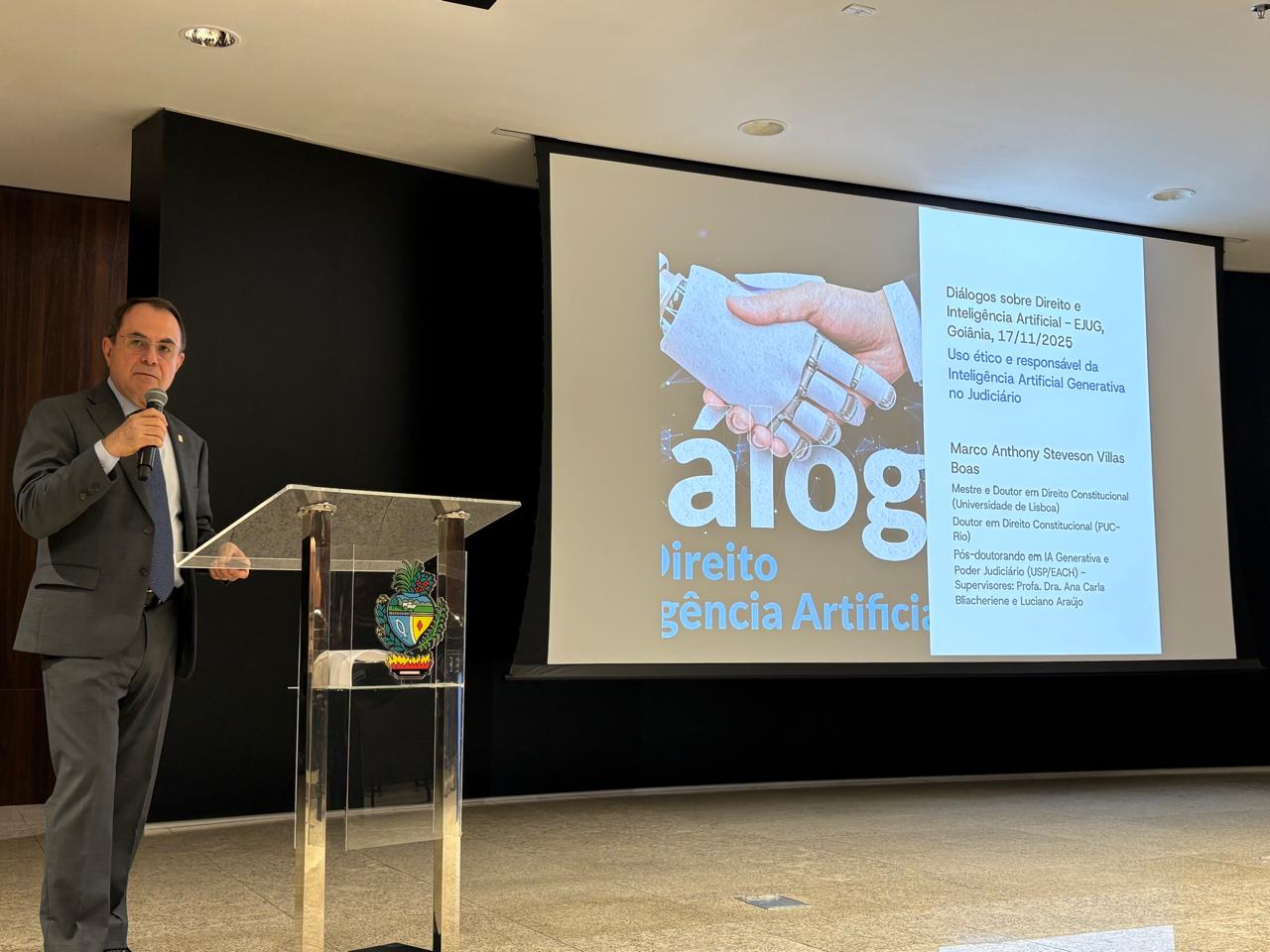
The Judicial School of the State of Goiás (Ejug) received, on Monday (November 17th), the general director of the Superior School of the Judges of the State of Tocantins (Esmat) and president of Copedem, Justice Marco Villas Boas, for the lecture on "Ethical and responsible use of Generative Artificial Intelligence in the Judiciary", within the event on "Dialogues on Law and Artificial Intelligence". Addressed to magistrates, civil servers and the general public, the exhibition addressed the uses, limits, risks and potentialities of AI in the Justice System, with emphasis on ethics, data security, judicial prediction, transparency and accountability, in line with the guidelines of the National Council of Justice (CNJ) and the agenda of Justice 4.0.
By presenting the historical path of information technologies to Generative AI, the lecturer stressed that tools such as the language models do not replace human discernment, should act as partners of critical thinking, and not as decision-making oracles. Villas Boas explained the Dialogic Multi-Response Method (DMR), developed in his postdoctoral studies, which uses AI to map multiple legally defensible solutions instead of indicating a single "correct" answer. The proposal, already tested in the Hórus Project, reinforces the role of the judge, broadens the visibility of different principles and applicable precedents and contributes to more informed decisions, transparent and aligned with fundamental rights.
Interdisciplinary dialogues
Throughout the exhibition, the justice also placed the debate in the light of important contemporary thinkers who problematize the relationship among technology, power and democracy. In dialogue with Zygmunt Bauman, he highlighted the risks of a "liquid modernity" in which social ties and rights guarantees can become even more fragile before automated decisions. In mentioning Noam Chomsky, he emphasized that AI systems can reinforce consensus-building dynamics and informational asymmetries if they are not regulated with transparency and social control.
From the reflections of Ray Kurzweil on technological acceleration, he drew attention to the fact that no cognitive leap will be truly humanizing if we deepen the opacity of algorithms, the precarization of work and the weakening of democratic institutions.
“The promises around Artificial Intelligence are many. We talk about extraordinary advances in medicine, jumps in data processing capacity, scenarios in which an Artificial Intelligence at a higher level, the so-called ASI, can support complex processes of environmental restoration, control of the greenhouse effect and responsible management of our natural resources. But it is necessary to remember that all this technological power only makes sense if it is at the service of a dignified life, the reduction of inequalities and the protection of rights. The true promise of AI cannot be mass unemployment, increased precariousness or deepening fears and insecurities. Our ethical commitment, as the Judiciary, is to guide the use of these tools to promote shared prosperity, strengthen public policies, broaden access to Justice and ensure that no innovation is an excuse for violating fundamental guarantees. In other words, technology should serve people, not the other way around," he said.
Tribute
In a moment of emotion and joy, Justice Marco Anthony Villas Boas was awarded the Professor Byron Seabra Guimarães Academic Merit Award, honor granted by Ejug in recognition of its significant contribution to the continuing training of magistrates and civil servers of the Judiciary.
Delivered by Justice Jeronymo Pedro Villas Boas, brother of Villas Boas and director of the Judicial School of the state of Goiás, the tribute symbolizes the strengthening of academic cooperation between the judicial schools and it highlights the role of the in critical reflection on the ethical use of artificial intelligence and the consolidation of innovative practices aimed at improving Brazilian Justice.
Laboratory
The lecture also dialogued with the recent creation of the Interinstitutional Laboratory of Artificial Intelligence of the Judicial School (LI 2 A-Ejug), established by the Judiciary Decree no 4.488, of 2025, signed by the president of the Court of Justice of the State of Goiás (TJGO), Justice Leandro Crispim. First AI laboratory of the TJGO, the LI 2 A-Ejug will be administered by Ejug, with the objective of developing applied research, technological innovation and institutional training in the ethical and responsible use of Artificial Intelligence within the scope of the Judiciary of the state of Goiás.
_thumbnail_thumbnail.jpeg)
_thumbnail_thumbnail.jpeg)
_thumbnail_thumbnail.jpeg)

_thumbnail.jpeg)
_thumbnail.jpeg)
_thumbnail.jpeg)